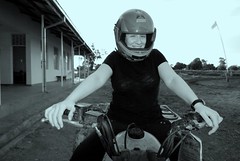
I can’t stop thinking about my six summers in Minnesota. Pagak is like sleep-away camp in that I’m spending plenty of time in the sun, walking around in tevas or riding a quad bike, discovering new breeds of spiders, and there are plenty of little fires around me. The smell of Ethio

pian food, distinct lack of sailboats and Jewish girls, and my visit to a PHCC/VCT (Primary Health Care Centre/Voluntary Counseling and Testing) clinic today should be enough to remind me that I’m no where near
Cass Lake. But it’s still a bit fun in a cheeky kind of way. I’m sure it will hit me by tomorrow – after a subsequent day of goat and using a wooden-box-sitting
latrine – that this is no paradise (haha) but until then, I’ll keep this plastered smile.
It seems like my little house is one of maybe 15 permanent structures in the entire ‘town,’ with the others belonging to other
iNGO compounds or facilities they’ve developed within the community itself. Even the local government is housed in a traditional structure. My space is great though - it’s bigger than my apartment in NY, far more light and airy, and I’ve got room for sleepovers if any of y’all want to visit. I can’t stress enough how delighted I am with my battery powered i-pod speaker, nor how I consistently surprise myself with the fluctuations in my cleanliness standards (note, Emily, there are no Clorox wipes here). It looks like there is a blood stain on my curtain.


The compound has about five of these small houses, four other tukuls, a few unnamed structures, including a chicken shack, and then a central area with the
office,
kitchen, ‘store,’ and canteen or
dining hall. It seems that all Nuer women’s names begin with Nya, making it a challenge to remember names and properly communicate with our support staff of cleaning and cooking ladies - Nyanaka, Nyamwuon, Nyapuka, Nyarwach, Nyalwal, Nyamwach, and Nyaduoth – oh and that only one speaks English compounds that difficulty. No worries. A big smile and guffaw gets me far. The dining hall was under renovation today; I should have inquired how frequently the place gets remudded. Again, huge language barrier. Zoom into grandma-in-red’s outfit; talk about easy access!


Some shots around the compound:
Jimmy, another intern, brought me to the health center that ‘we’ have put in place, though Save isn’t operating it directly, and it is under the control of the local health ministry, if you will. I say this, because it functions at a depressingly low capacity. The nine to five, five days a week signage, made me ask him, “What happens if someone is really sick?” he straight-forwardly replied, “they die.”


On that note,
Kate wrote a really beautiful and striking piece about health and the massive implications on human, social, and economic development:
Think about the last time you were sick...
I mean really sick, with something infectious. None of that stuffy nose and cough type thing. What was it? The flu? Strep throat? What if it was tuberculosis? Or malaria? Or leprosy? Or river blindness? In the short time I've been here I have seen more people with diseases that have been entirely or mostly eradicated from the North (or the West, however you like to phrase it) than I can count. After seeing a blind man making his way along the main road by himself with nothing but a stick, it was explained to me that river blindness has left 1/4 of the people in villages nearby blind. One in four people. Take a minute to think about that. If 1/4 people in the US were blind how would it impact our capacity to run our government, let alone our economy. …. So if 25% of the population has river blindness, and the leprosy rate is somewhere between 10 and 30%, and 70% of the world's remaining burden of Guinea Worm is in South Sudan, not to mention the worms crawling around in the bellies of most kids (ring worm (okay it's a fungus, still pertinent) is particularly obvious as you see kids with black hair with white polka dots), the micronutrient and calorie deficiencies of kids and whole families. The list goes on. Where does that leave the people living here? There is development under way and with immunizations slowly becoming commonplace there are less disease outbreaks, and the menningitis and measles outbreak that occurred last year was contained relatively quickly with the efforts of NGOs, the government and the community. But even so, the impact that ill health can have on development has never been more apparent. Consider that many micronutrient deficiencies can lead to slowed mental development and mental retardation if not corrected within the first years of life, or that anemia makes children and adults alike tired, think more slowly and have less energy for daily activities. You have a huge proportion of the population that is entirely absent from productive activities because of their health. So, as many workshops as you do and as much capacity as you build in the community, the physical capability of the population is severely limited by its ill health. …. But then there's nodding disease. Ever heard of it? That's because it only exists in South Sudan and no one knows what causes it. It mostly affects young children, causes seizures that make the children look like they're nodding, and leads to mental retardation, and then as it progresses is almost 100% fatal. A few people are studying it, google it for some more in depth info. But I've visited schools and looked at the rosters and you see so many kids listed as "nodding" or having "fits". So if you've got all the issues listed above, plus anywhere from 5-25% of your children will have retarded mental development or will most likely die, it's just one more giant pothole in the pathway to development. So, for anyone who wonders what on earth I'm doing in South Sudan, it's doing the first survey in memory of the health status of Southern Sudanese children in this county. And hopefully, as with all data, it will be put to good use, will move and inspire donors and other organizations, and all the other big things I imagine happening. But at the very least, the kids here won't be invisible anymore, because someone will have documented what it's like to live here.


 .
.